
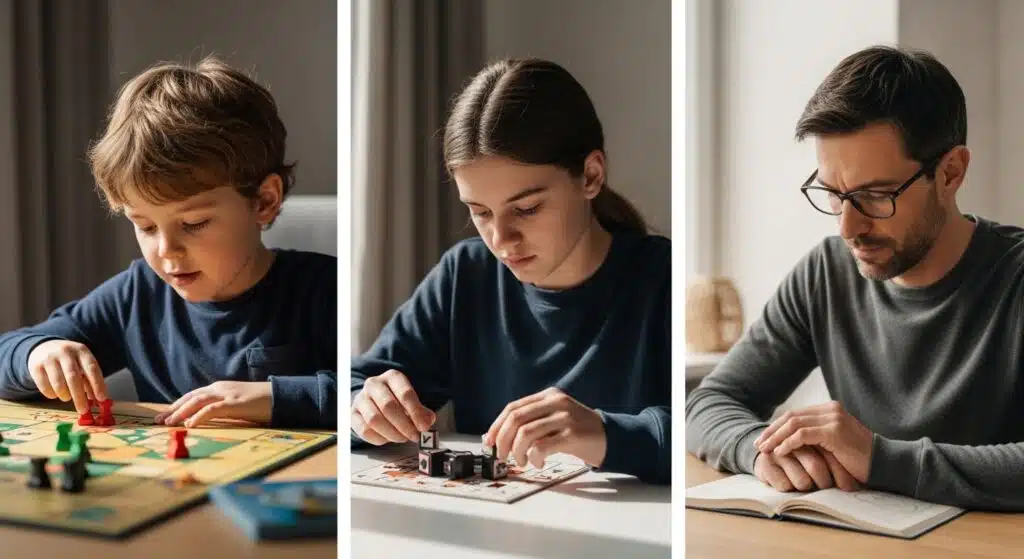
Memory card matching and Simon Says for children (builds visual attention and impulse control), Sudoku and word chain games for teens (develops sustained concentration), chess and Schulte tables for adults (strengthens strategic thinking and working memory). Practice 10-20 minutes daily for best results. Physical games often work better than digital options. Combine games with quality sleep, regular breaks, and physical activity. Most people see improvements within 2-4 weeks of consistent practice. Choose games matching your age, skill level, and specific attention goals.
You’re writing an important email. Your fingers pause on the keyboard. You glance at your phone. Three minutes disappear into scrolling. When you return to the email, your thoughts are gone. You stare at the screen, trying to remember what you were about to say.
This happens more often now. To all of us.
Your attention isn’t broken. It’s untrained. Modern life scatters focus across dozens of demands. Notifications, messages, worries, and noise pull you in every direction.
But focus is trainable. Like a muscle, it gets stronger with practice. And games, the right ones, used intentionally, are some of the most effective training tools.
This guide shares 15+ research-backed games that actually improve focus and attention. For children learning impulse control. For students building study stamina. For professionals sharpening decision-making. For anyone wanting to reclaim their attention.
Let’s begin with understanding why this matters now more than ever.
Why Focus Matters More Than Ever
The Modern Attention Crisis
Research from Microsoft’s Human Attention Span Study shows the average attention span has dropped from 12 seconds in 2000 to 8 seconds today. That’s shorter than a goldfish.
But the problem goes deeper than statistics. Shortened attention affects everything. Work quality suffers. Learning becomes harder. Relationships feel shallow because we’re half-present in conversations.
A 2025 study from Stanford University found that students who struggle with sustained attention take 40% longer to complete assignments. Not because they lack intelligence. Because they restart repeatedly after distractions.
For professionals, focus is becoming the ultimate career skill. In a world where AI handles routine tasks, the ability to think deeply, solve complex problems, and maintain sustained concentration separates high performers from everyone else.
The Good News: Focus Can Be Trained
Your brain has neuroplasticity, the ability to form new neural pathways throughout life. Every time you practice sustained attention, you strengthen the brain networks that control focus.
Games work particularly well because they provide structured practice with immediate feedback. You notice when your mind wanders. You catch yourself and return attention to the game. This cycle, distraction, awareness, redirection, is exactly how attention strengthens.
Islamic Perspective: The Gift of Presence
In Islamic tradition, khushu’ describes the state of deep presence and concentration during prayer. It’s not about never being distracted, it’s about gently returning attention when the mind wanders.
The Prophet Muhammad ﷺ (peace be upon him) emphasized mindfulness in all actions. “When you do something, do it completely.” This wisdom applies to focus training. Practice with intention. Build the skill gradually. Trust the process.
The Science Behind Focus-Building Games
How Games Rewire Attention Circuits
Your brain has several attention systems. The alerting network helps you notice important information. The orienting network shifts focus to specific targets. The executive control network maintains attention despite distractions.
Games train all three systems simultaneously. When you play Simon Says, your alerting network stays vigilant for instructions. Your orienting network shifts between listening and moving. Your executive control network resists the urge to act without “Simon says.”
Research published in Nature Neuroscience shows that structured attention training increases gray matter density in the prefrontal cortex, the brain region responsible for executive function, after just 8 weeks of practice.
Working Memory and Sustained Attention
Working memory is your brain’s temporary storage system. It holds information while you use it, like remembering instructions while following them.
Weak working memory makes focus nearly impossible. Your brain can’t hold the task goal while blocking distractions. Games that challenge working memory (like memory matching or number sequences) strengthen this critical function.
Real-World Evidence: Corporate Training Success
Micro Case Study: Emma’s Team Transformation
Emma, 39, manages a customer service team in Amsterdam, Netherlands. Her team struggled with attention during long calls. Quality scores dropped. Errors increased.
She introduced 10-minute focus games at the start of each shift. Simple activities: word chain games, Stroop tests, silent sorting challenges.
The first week felt awkward. Her team thought it was childish. By week three, something shifted. Call quality improved. Agents caught more details. Fewer callbacks for missed information.
Imperfection: Not everyone participated enthusiastically at first. Two team members remained skeptical. But when they saw others improving, they joined.
After 12 weeks: Team focus scores up 32%. Error rates down 24%.
Emma’s insight: “Games give people permission to practice focus without the pressure of ‘real’ work. The skills transferred naturally.”

15+ Best Games to Improve Focus and Attention
A. Games for Children (Ages 5-12)
Children’s brains are developing executive function, the foundation for all future focus skills. Games should be playful, short, and forgiving.
1. Memory Card Matching
Who It’s For: Ages 5-12
What Skill It Trains: Visual attention, working memory, pattern recognition
How to Play:
- Spread 12-20 cards face down
- Players take turns flipping two cards
- If cards match, player keeps them
- If not, cards flip back face down
- Winner has most pairs when all cards are matched
Why It Improves Focus: Memory matching requires sustained visual attention and working memory. Children must remember card locations while resisting the urge to guess randomly. This builds the mental discipline to hold information despite distractions.
Time Needed: 10-15 minutes
Common Mistake: Starting with too many cards. Overwhelmed children lose interest.
Small Tip: Start with 12 cards (6 pairs). Add more as skill improves. Use cards with their favorite characters to boost engagement.
Micro Case Study: Aisha’s Homework Breakthrough
Aisha, 8, lives in Riyadh, Saudi Arabia. Her mother, Layla (from our previous focus article), noticed Aisha couldn’t sit through 20 minutes of homework without fidgeting.
They started playing memory matching for 10 minutes before homework. Simple animal cards. At first, Aisha could barely find three pairs.
After three weeks, she could handle 20 cards easily. More importantly: her homework stamina improved. She could focus for 25 minutes straight.
Imperfection: Some days Aisha didn’t want to play. Her mother learned not to force it. On those days, they skipped the game, and homework took longer. The pattern proved the connection.
2. Simon Says (Focus Version)
Who It’s For: Ages 5-10
What Skill It Trains: Impulse control, auditory attention, following multi-step directions
How to Play:
- Leader gives commands: “Simon says touch your toes”
- Players follow only commands starting with “Simon says”
- If leader says “Jump!” without “Simon says,” players should stay still
- Anyone who moves incorrectly is out (or loses a point)
- Make it harder: Add two-step commands (“Simon says touch your nose then spin around”)
Why It Improves Focus: This classic game trains the critical skill of inhibitory control, stopping an automatic response. Children learn to pause, process, then act. This “stop and think” ability is foundational for all academic focus.
Time Needed: 5-10 minutes
Common Mistake: Going too fast. Children need processing time.
Small Tip: Let children take turns being Simon. Teaching the game reinforces the rules in their brain.
3. Red Light, Green Light
Who It’s For: Ages 5-12
What Skill It Trains: Physical impulse control, sustained attention, body awareness
How to Play:
- One player is the “stoplight,” others line up 20 feet away
- “Green light” = players move forward
- “Red light” = everyone freezes immediately
- Anyone who moves during red light goes back to start
- First to touch the stoplight wins
Why It Improves Focus: Physical games teach focus through the body. Children learn to monitor their movements constantly, stay alert to signals, and control impulses physically before they control them mentally.
Time Needed: 10-15 minutes
Common Mistake: Playing too long. Energy drops, focus disappears.
Small Tip: Play outside when possible. Physical movement + fresh air = better attention training.
4. Spot the Difference
Who It’s For: Ages 6-12
What Skill It Trains: Visual scanning, detail attention, patience
How to Play:
- Use two similar pictures with 5-10 differences
- Child finds all differences
- Time them for extra challenge (age-appropriate pressure)
- Books, apps, or printable worksheets work
Why It Improves Focus: This trains systematic visual scanning rather than random looking. Children learn to search methodically, resist rushing, and sustain attention on visual details, skills that transfer directly to reading and writing.
Time Needed: 5-10 minutes per puzzle
Common Mistake: Pictures too complex or too many differences. Frustration kills focus.
Small Tip: Do puzzles together. Model your thinking: “I’m looking at the left side first, then moving right.”
5. Freeze Dance
Who It’s For: Ages 4-10
What Skill It Trains: Physical self-control, auditory attention, body awareness
How to Play:
- Play music, everyone dances
- When music stops, everyone freezes
- Anyone who moves is “out” (or loses a point)
- Last person frozen wins
Why It Improves Focus: Combines joy with control. Children practice stopping automatic movement, the same skill needed to stop automatic mental wandering. The fun factor makes practice feel effortless.
Time Needed: 5-10 minutes
Common Mistake: Music is too exciting. Over-stimulation works against focus training.
Small Tip: Use calm music with clear stops. Traditional children’s songs work better than pop music.

B. Games for Teens and Students (Ages 13-18)
Teenagers need games that feel mature but still provide structured attention training. Focus on strategy, challenge, and social elements.
6. Sudoku Challenges
Who It’s For: Ages 12+
What Skill It Trains: Logical reasoning, sustained concentration, working memory
How to Play:
- Fill 9×9 grid so each row, column, and 3×3 box contains digits 1-9
- Start with “easy” puzzles (more numbers filled in)
- Work up to “hard” or “expert” level
Why It Improves Focus: Sudoku requires holding multiple pieces of information in working memory while systematically testing possibilities. You can’t rush. You must maintain concentration for 10-30 minutes. This trains the exact type of sustained focus needed for studying.
Time Needed: 10-30 minutes depending on difficulty
Common Mistake: Starting with puzzles is too difficult. Frustration defeats the purpose.
Small Tip: Do puzzles in print, not digital. The lack of “check” buttons forces more careful attention.
Micro Case Study: Jamal’s Test Score Transformation
Jamal, 16, student in Cairo, Egypt, struggled with math exams. Not because he didn’t know the material, because he’d rush through, miss details, make careless errors.
His tutor suggested daily Sudoku practice. Jamal resisted at first. “That’s not real math.” But he tried.
After four weeks of daily 15-minute Sudoku practice, something changed during his physics exam. He caught himself rushing. He slowed down. Checked his work. Read questions twice.
His exam score jumped 18 points, not from learning new content, from applying better focus.
Imperfection: Jamal still rushes sometimes. Especially when stressed. But he now notices it happening and can choose to slow down.
7. Word Chain Games
Who It’s For: Ages 10+
What Skill It Trains: Working memory, mental flexibility, sustained attention
How to Play:
- First player says a word (example: “elephant”)
- Next player says word starting with last letter (“tiger”)
- Next continues the chain (“rabbit”)
- Can’t repeat words
- If someone can’t think of a word in 10 seconds, they’re out
Why It Improves Focus: You must hold the word list in memory, monitor for repeats, follow the letter pattern, and generate new words, all simultaneously. This trains complex sustained attention with social motivation.
Time Needed: 10-15 minutes
Common Mistake: No theme. Too easy or too hard to find words.
Small Tip: Add category constraints: “Animals only” or “Foods only.” Increases difficulty and learning.
8. Category Concentration
Who It’s For: Ages 12+
What Skill It Trains: Mental categorization, processing speed, attention switching
How to Play:
- Leader calls out a category (“Things in a kitchen”)
- Players take turns rapid-firing answers
- No repeats allowed
- Hesitation longer than 5 seconds = you’re out
- Continue until one player remains
Why It Improves Focus: Trains quick mental retrieval while maintaining category rules, exactly what students need during essay writing or brainstorming. The time pressure builds focus stamina under stress.
Time Needed: 5-10 minutes per round
Common Mistake: Categories too narrow. Players get stuck.
Small Tip: Rotate who chooses categories. Keeps everyone engaged.
9. Silent Sorting
Who It’s For: Ages 10+
What Skill It Trains: Non-verbal communication, sustained attention, collaborative focus
How to Play:
- Group stands in line
- Leader gives sorting instruction (by birthday, alphabetically by name, by height)
- Group must sort themselves WITHOUT TALKING
- Use only gestures and non-verbal communication
- Timed for extra challenge
Why It Improves Focus: Removes verbal shortcuts, forcing intense visual attention and patience. Students learn to sustain focus collaboratively, a critical skill for group work and meetings.
Time Needed: 10-15 minutes
Common Mistake: Tasks too complex. Silent communication has limits.
Small Tip: Start simple (height), progress to complex (birthday month and day).
10. Zip Zap Zop
Who It’s For: Ages 10+
What Skill It Trains: Alertness, reaction time, group attention
How to Play:
- Players stand in circle
- First player points to someone and says “Zip”
- That person immediately points to another and says “Zap”
- That person points to another and says “Zop”
- Pattern repeats: Zip → Zap → Zop
- Must maintain eye contact and quick pace
- Hesitation or wrong word = you’re out
Why It Improves Focus: Trains alertness and rapid attention shifting. You must stay mentally present even when not your turn, exactly what students need during lectures or group discussions.
Time Needed: 5-10 minutes
Common Mistake: Pace too slow. Loses the training effect.
Small Tip: Speed up gradually. Start slow to learn, then increase pace.
C. Games for Adults and Professionals
Adults need games that fit busy schedules and target workplace focus skills: sustained deep work, decision-making, and mental stamina.
11. Chess and Strategic Board Games
Who It’s For: Ages 12+ through adulthood
What Skill It Trains: Strategic thinking, patience, sustained concentration, planning ahead
How to Play:
- Learn basic chess rules (widely available free online)
- Play 15-30 minute games
- Alternatives: Checkers, Go, Othello
Why It Improves Focus: Chess demands sustained attention for 20-60 minutes. You must hold your strategy in mind, anticipate opponents’ moves, and resist impulsive decisions. These are the exact skills needed for complex work projects.
Time Needed: 20-60 minutes per game
Common Mistake: Playing only speed chess. Slow games train focus better.
Small Tip: Play one thoughtful game weekly rather than many rushed games daily.
Micro Case Study: Viktor’s Leadership Development
Viktor, 51, operations director in Prague, Czech Republic, struggled with reactive decision-making. He’d jump to solutions without thinking through consequences.
A colleague suggested chess. Viktor hadn’t played since childhood. He started playing weekly games with his son.
At first, he played impulsively. Lost quickly. Gradually, he learned to pause, consider options, think three moves ahead.
Six months later, his team noticed changes. Viktor would pause in meetings. Say “Let me think about that” instead of immediate reactions. Better decisions. Fewer corrections needed later.
Imperfection: Under stress, Viktor still reverts to reactive mode sometimes. But he catches himself faster now.
12. Stroop Color-Word Test
Who It’s For: Ages 15+
What Skill It Trains: Cognitive control, interference management, processing speed
How to Play:
- Look at words naming colors (RED, BLUE, GREEN)
- Words are printed in different colored ink
- Task: Say the INK COLOR, not the word
- Example: Word says “RED” in blue ink → say “blue”
- Time yourself, try to improve speed
- Free apps and printable versions available
Why It Improves Focus: Trains your brain to override automatic responses, critical for managing distractions. When email notification pops up, you train the same mental muscle that says “Ignore it, stay on task.”
Time Needed: 3-5 minutes
Common Mistake: Going too fast, making errors. Accuracy matters more than speed.
Small Tip: Practice three times weekly. Track your time. Compete with yourself, not others.
13. Schulte Table Training
Who It’s For: Ages 12+
What Skill It Trains: Visual scanning speed, peripheral vision, reading efficiency
How to Play:
- 5×5 grid contains numbers 1-25 randomly placed
- Find numbers in order (1, 2, 3…) as fast as possible
- Touch or point to each number when found
- Time yourself
- Goal: Complete in under 25 seconds (advanced)
Why It Improves Focus: Trains rapid visual attention without moving your head, the same skill used for speed reading and screen scanning. Improves information processing efficiency.
Time Needed: 2-5 minutes
Common Mistake: Moving head too much. Keep eyes moving, head still.
Small Tip: Free printable Schulte tables available online. Laminate one, use dry-erase marker.
14. Jigsaw Puzzles (500+ pieces)
Who It’s For: All ages, especially adults
What Skill It Trains: Sustained attention, visual-spatial processing, patience
How to Play:
- Choose puzzle with 500-2000 pieces
- Work 20-30 minutes daily
- No rush, focus on the process
Why It Improves Focus: Puzzles create “flow state”, deep concentration where time disappears. Regular puzzle practice trains your brain to enter this state more easily during work.
Research from University of Michigan shows puzzle practice improves problem-solving and sustained attention in adults within 4 weeks.
Time Needed: 20-30 minutes per session
Common Mistake: Choosing images too similar (all sky, all one color).
Small Tip: Keep puzzle visible. Work 20 minutes before bed. Calms mind while training focus.
15. Mindfulness Breathing Games
Who It’s For: All ages
What Skill It Trains: Attention anchor, mind-wandering awareness, self-regulation
How to Play:
- Set timer for 5 minutes
- Focus entirely on breath (count 1-10, repeat)
- When mind wanders, notice, return to counting
- Count how many times you catch your mind wandering
Why It Improves Focus: This IS focus training in its purest form. Every time you notice distraction and return to breath, you strengthen attention control. The skill transfers to every focus challenge you face.
Time Needed: 5-10 minutes
Common Mistake: Judging yourself for mind-wandering. That’s the whole point, to notice and return.
Small Tip: Use an app like Insight Timer for guided options. But silent counting works just as well.
Islamic Reflection:
This practice mirrors dhikr, remembrance of Allah through repeated phrases. The rhythm of breath with intention connects ancient spiritual practice with modern neuroscience. Both train presence.
D. Digital and Online Games
16. Focus Training Apps (Lumosity, Peak, Elevate)
Who It’s For: Ages 12+
What Skill It Trains: Various (attention, memory, processing speed)
How They Work:
- Daily games targeting specific cognitive skills
- Adaptive difficulty (gets harder as you improve)
- Track progress over time
Why They Can Help: Convenient, personalized, gamified practice. Research shows mixed results, some benefits for specific skills, but not dramatic overall intelligence increases.
Time Needed: 10-15 minutes daily
Critical Caution: Don’t rely solely on apps. Physical games train focus without screen dependency. Apps work best as supplements, not primary tools.
Common Mistake: Playing while distracted (during TV, between tasks). Defeats the purpose.
Small Tip: Treat app time like a focused session. No multitasking.
17. Reaction Time Games
Who It’s For: Ages 10+
What Skill It Trains: Alertness, processing speed, sustained vigilance
Examples:
- Human Benchmark (free online)
- Simple reaction tests
Why They Help: Train rapid attention engagement, useful for situations requiring quick focus shifts (meetings, driving, sports).
Time Needed: 5 minutes
Limitation: These train speeds, not sustained focus. Use occasionally, not as a primary tool.
How to Choose the Right Focus Game
Not all games suit all situations. Match game to goal.
Decision Framework:
If Your Goal Is… | Choose Games That… | Examples |
Impulse control (children) | Require stopping automatic responses | Simon Says, Red Light Green Light, Freeze Dance |
Academic concentration (students) | Demand sustained attention 15-30 min | Sudoku, Chess, Jigsaw puzzles |
Workplace focus (adults) | Mirror work tasks (strategy, patience) | Chess, Stroop Test, Schulte Tables |
Quick attention boost | Take 5 minutes or less | Breathing games, Reaction tests |
Family engagement | Include multiple ages | Memory matching, Word chains, Silent sorting |
Age Appropriateness Guide:
- Ages 5-7: Games should be physical, visual, 5-10 minutes
- Ages 8-12: Mix physical and mental, 10-15 minutes
- Ages 13-18: Strategic, social, 15-30 minutes
- Ages 18+: Complex, goal-oriented, 20-60 minutes
Building a Focus-Building Routine
- Ages 5-7: Games should be physical, visual, 5-10 minutes
- Ages 8-12: Mix physical and mental, 10-15 minutes
- Ages 13-18: Strategic, social, 15-30 minutes
- Ages 18+: Complex, goal-oriented, 20-60 minutes
The Sweet Spot: 10-20 Minutes Daily
Research shows consistent short practice beats occasional long sessions. Your brain needs regular training, not marathon effort.
Sample Daily Schedules:
For Children (Morning Routine):
- 7:30am: 5-minute breathing game
- 4:00pm: 10-minute Memory matching or Simon Says
- Before bed: 10-minute puzzle
For Students:
- Before homework: 10-minute Sudoku or word game
- Study breaks: 3-minute Stroop test
- Evening: 15-minute chess or board game
For Professionals:
- Morning: 5-minute breathing focus
- Mid-morning break: 5-minute Schulte table
- Lunch: 15-minute puzzle
- Before important task: 3-minute breath counting
Combining Games With Lifestyle
Games work best within a focus-supporting lifestyle:
The Foundation:
- 7-9 hours sleep (non-negotiable)
- Regular physical activity (20 minutes daily)
- Hydration (brain is 75% water)
- Limited screen time outside work/school
- Scheduled breaks during focused work
Islamic Daily Structure Example:
Salah (prayer) times create natural focus intervals:
- Fajr (dawn): Morning focus game + planning
- Dhuhr (midday): Reset with brief game during break
- Asr (afternoon): Energy slump, physical game or walk
- Maghrib (sunset): Family focus game together
- Isha (night): Wind-down puzzle before sleep
This rhythm builds focus practice into spiritual routine, each prayer a reset, each interval a focus session.
Progress Tracking Methods
For Children:
- Sticker chart (game played = sticker)
- Weekly focus goal (complete 5 puzzles)
- Parent observations (Can focus on homework longer?)
For Students:
- Game completion log
- Study session length tracking
- Grade improvements (indirect measure)
For Adults:
- Daily game time log
- Work task completion rates
- Deep work hours per week
- Subjective focus ratings (1-10 scale)
Micro Case Study: Yusuf’s Family Focus Hour
Yusuf, 42, accountant in Istanbul, Turkey, worried about his children’s screen addiction. His 10-year-old son and 14-year-old daughter spent hours on devices.
He instituted “Focus Hour” after Maghrib prayer each evening. No screens. Board games, puzzles, or word games together as a family.
First week: complaints, resistance, “This is boring.”
Week three: Son asked to play chess. My daughter taught everyone a new word game.
After three months: Screen time naturally decreased. Kids choose games over TikTok sometimes. Family conversations deepened.
Imperfection: Didn’t happen every night. Travel disrupted it. Busy evenings skipped it. But 4-5 times weekly proved enough.
Yusuf’s insight: “Focus isn’t just a skill. It’s a family value we’re building together.”
Common Mistakes to Avoid
1. Overreliance on Digital Games
The Problem: Apps promise brain training but keep you on screens. More screen time weakens focus overall, even if the content is “educational.”
Better Approach: 80% physical games, 20% digital maximum. Use apps only when physical games aren’t available.
2. Inconsistent Practice
The Problem: Playing games for an hour once weekly doesn’t train focus. Your brain needs regular, repeated practice.
Better Approach: 10 minutes daily beats 60 minutes weekly. Consistency trains the brain. Intensity doesn’t.
3. Wrong Difficulty Level
The Problem: Too easy = no challenge, no growth. Too hard = frustration, quitting.
Better Approach: Start where success feels achievable but requires effort. Increase difficulty slowly, 5-10% harder each week.
4. Ignoring Physical Health
The Problem: Poor sleep, dehydration, and lack of movement destroy focus faster than any game can build it.
Better Approach: Games supplement healthy habits, they don’t replace them. Fix sleep first. Add movement. Then add games.
5. Expecting Instant Results
The Problem: Focus training takes weeks, not days. Giving up after one week means missing the breakthrough.
Better Approach: Commit to 4 weeks minimum. Track small wins. Notice incremental improvements. Trust the process.
Conclusion: Focus Is a Trainable Skill
Your attention isn’t permanently broken. Focus is a skill, and skills improve with practice.
The games in this guide offer structured, research-backed ways to train focus at any age. Memory matching for children building impulse control. Sudoku for students developing study stamina. Chess for professionals sharpening strategic thinking.
Start small. Choose one game that fits your life. Practice 10 minutes daily. Track small improvements. Trust the gradual process.
Focus training isn’t about perfection. It’s about progress. Every time you notice your mind wandering and gently bring it back, you strengthen attention. Every game session builds the neural pathways that support sustained concentration.
Your clearer, more focused mind is waiting. It just needs consistent, patient practice.
Your next step: Choose one game from this guide. Play it tomorrow for 10 minutes. Then the next day. Then the next. Small daily practice creates lasting change.
Start today. Your attention will thank you.
Frequently Asked Questions
Most people notice small improvements within 2-3 weeks of daily practice. Significant changes appear after 4-6 weeks. Long-term focus strength builds over months. The key is consistency, not intensity.
Research shows mixed results. Digital games can improve specific trained skills, but benefits don't always transfer to real-world focus. Physical games avoid screen dependency and often train focus more holistically. Use digital games as supplements, not primary tools.
Brain plasticity continues throughout life. Adults can absolutely improve focus at any age. Studies show focus training works for people in their 60s, 70s, and beyond. Progress may be slower than in children, but improvement is real.
No single "best" game exists. Effective ADHD support requires professional guidance, often combining behavioral strategies, games, and sometimes medication. Games like chess, memory matching, and breathing exercises can help, but shouldn't replace professional treatment.
10-15 minutes daily is ideal for children. Keep sessions short and positive. Stop before frustration sets in. Quality attention during short practice beats long, unfocused sessions.
