
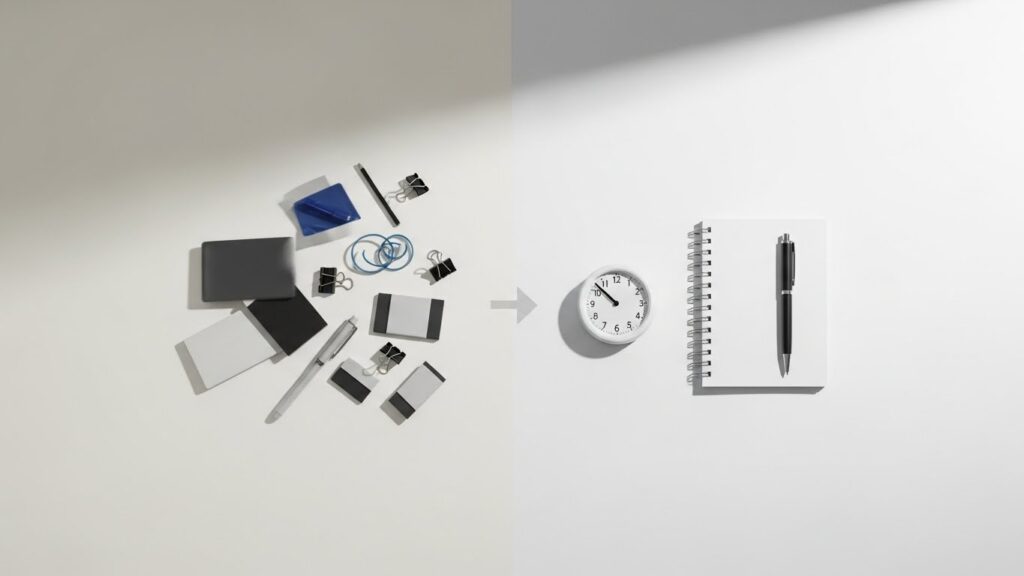
The Modern Adult Focus Crisis
Sophia sat through a 2-hour strategy meeting in Milan.
When her boss asked for her input, her mind went blank.
She’d been physically there. Mentally? Somewhere between emails, dinner planning, and tomorrow’s deadlines.
Sound familiar?
Your adult brain faces 35,000 decisions daily. Digital notifications interrupt you 86 times. Multitasking culture destroys deep work.
Research from Microsoft Workplace Studies shows adults lose 2.5 productive hours daily to broken focus.
But here’s the truth: your scattered attention isn’t aging. It’s untrained.
In this guide, you’ll discover 10 science-backed focus exercises for adults. These methods rebuild concentration in 4-6 weeks. They fit your busy professional life.
Your focus can sharpen at any age. Let’s begin.
The Adult Attention Challenge
Adult brains face unique focus challenges children never experience.
You’re juggling work deadlines, family duties, finances, health worries, social demands, and digital chaos.
Your attention gets pulled in 20 directions at once.
The Adult Brain Science
Your prefrontal cortex runs an executive function. It handles decisions, focus, and planning.
It gets depleted faster in adults. You make 35,000+ choices daily. Children? About 3,000.
This creates decision fatigue. By 2 PM, your mental energy drops sharply.
According to Harvard Medical School, chronic stress shrinks your hippocampus by 20%. Poor sleep cuts focus capacity in half.
What Destroys Adult Focus
Focus Killer | Adult Impact | Research Source |
Work multitasking | 40% productivity loss | Microsoft Workplace Studies |
Digital alerts | 86 daily interruptions | RescueTime Report |
Decision fatigue | Mental depletion by 2 PM | Journal of Applied Psychology |
Chronic stress | 20% hippocampus shrinkage | Harvard Medical School |
Poor sleep | 50% focus capacity loss | Sleep Research Society |
Real Story: Marcus, Dubai
Marcus, 42, operations manager from Dubai, couldn’t focus on quarterly reports anymore.
His mind wandered after 3 minutes. He felt his edge slipping.
After 6 weeks of focus exercises, he analyzed complex data for 75 minutes straight. His strategic insights improved. His confidence returned.
The Hopeful Truth
Adult focus decline isn’t inevitable aging.
It’s environmental. It’s trainable.
Your brain keeps neuroplasticity throughout life. Current neuroscience research confirms focus exercises rebuild attention at any age.
You can learn. You can improve. You can focus deeply again.
Islamic Wisdom on Deep Thought
The practice of tafakkur (deep contemplation) requires sustained focus.
The Prophet Muhammad ﷺ spent hours in reflection. The Quran encourages: “Indeed, in the creation of the heavens and earth… are signs for those of understanding—those who remember Allah… and give thought to the creation.” (3:190-191)
Deep thought demands trained attention. Age brings wisdom. Focus must be maintained through practice.
Science-Backed Techniques for Adult Concentration
These exercises address adult-specific attention challenges.
Each fits busy professional schedules.
Start with 2-3 exercises. Build from there.
CATEGORY 1: Cognitive Focus Exercises
Exercise 1 — Structured Work Intervals (Adult Pomodoro)
What It Is:
Work on one task for 25 minutes with complete focus. Take a 5-minute complete break. No work thoughts allowed.
After 4 cycles, take 15-30 minutes off.
Adjust intervals based on your attention capacity.
Why Adults Need This:
Adults handle complex tasks needing sustained attention. Traditional multitasking destroys this capacity.
Harvard Business Review reports 40% efficiency gains for knowledge workers using structured intervals.
Real Application:
Fatima, 38, financial analyst in Riyadh, worked 10 hours feeling drained. She produced average work.
After structured intervals, she completed better analysis in 6 hours. Her manager noticed improved accuracy. She got high-stakes projects.
Implementation Steps:
- Download timer app (Forest, Focus@Will, Be Focused)
- Schedule intervals around meetings
- Communicate boundaries to colleagues
- Protect focus blocks like important meetings
- Turn off all notifications during intervals
Adult-Specific Tip: Your optimal interval might be 35 or 45 minutes, not 25. Adults often have longer natural focus cycles than younger workers.
Exercise 2 — Strategic Reading Practice
What It Is:
Choose professional reading material. Set the timer for 15 minutes. Read without checking your phone or email.
Gradually extend to 30-45 minutes. Track comprehension quality.
The Science:
Deep reading activates prefrontal and temporal cortex networks simultaneously.
Research from Reading Research Quarterly shows reading with recall enhances comprehension focus by 35% in adults.
Career Impact:
Omar, 45, consultant in Kuwait City, couldn’t read industry reports anymore. His attention scattered after 5 minutes.
After 5 weeks of strategic reading, he absorbed 40-page reports thoroughly. His client recommendations became more insightful. His reputation grew.
Adult Implementation:
- Read mornings before checking email
- Use professional development materials
- Summarize key points aloud after reading
- Increase duration by 5 minutes weekly
- Keep reading journal for insights
Exercise 3 — Memory Sequencing (Adult Level)
What It Is:
Remember 7-10 items in specific order. Use meeting agenda points, project steps, or client names.
Recall without notes after 2 minutes. Increase to 12-15 items over weeks.
Why This Works:
Working memory and attention are interconnected in adult cognition.
Adults benefit more from practical memory exercises using real work content.
Business Application:
Layla, 36, project manager in Casablanca, constantly forgot meeting points. She checked notes every 2 minutes during discussions.
After memory sequencing practice, she recalled 10-point agendas naturally. Her meetings became more dynamic. Her team respected her mental clarity.
Practice Method:
- Write down 7-10 work-related items
- Study for 2 minutes
- Cover the list
- Recall in exact order
- Check accuracy
- Add 1-2 items next week
Exercise 4 — Focused Problem-Solving
What It Is:
Choose one work problem. Focus on it exclusively for 20 minutes. No interruptions, no research, just thinking.
Write insights immediately after.
Adult Benefit:
Deep thinking requires sustained attention adults rarely practice anymore.
Journal of Applied Psychology shows focused thinking sessions improve decision quality by 28%.
Real Success:
Rashid, 41, entrepreneur in Beirut, made impulsive decisions.
After daily focused thinking sessions, his strategic planning improved markedly. His business pivots became more thoughtful. His success rate increased.
Implementation:
- Choose one strategic challenge
- Find quiet space (office, car, park)
- Set timer for 20 minutes
- Think deeply without distractions
- Document insights immediately
- Apply one insight within 24 hours
CATEGORY 2: Physical Focus Exercises

Exercise 5 — Mindful Movement Breaks
What It Is:
Every 90 minutes, take a 5-minute mindful walk. Focus on breath, steps, body sensations.
No phone. No work thoughts. Return refreshed to desk.
Dual Benefit:
Movement increases adult brain oxygen by 23%. Mindful attention training multiplies the benefit.
Mayo Clinic Adult Health Research shows movement breaks improve afternoon focus by 31%.
Workplace Application:
Nadia, 39, HR director in Doha, hit mental walls every afternoon.
After implementing movement breaks, her 2 PM fog disappeared. Her afternoon meetings became as sharp as morning ones.
How to Practice:
- Set 90-minute timer
- Walk hallways, stairs, or outside
- Notice breath and footsteps
- Feel your body moving
- Return with fresh perspective
Exercise 6 — Cross-Body Coordination
What It Is:
Touch right elbow to left knee: 10 times. Touch left elbow to right knee: 10 times.
Alternate slowly with full attention. Practice 2 minutes, 2-3 times daily.
Why It Works:
Engages both brain hemispheres simultaneously. Improves neural communication and attention coordination.
Adult Benefit:
Ibrahim, 44, architect in Istanbul, felt his spatial reasoning declining.
Cross-body exercises restored his design focus. His blueprint analysis became sharper within 4 weeks.
Practice Tips:
- Stand with feet shoulder-width apart
- Move slowly with intention
- Focus on coordination, not speed
- Breathe naturally throughout
- Practice during work breaks
Exercise 7 — Hand-Eye Coordination Drills
What It Is:
Try juggling (start with 2 balls), table tennis, or craft work requiring precision.
Practice 10-15 minutes, 3 times weekly.
Adult Application:
Requires sustained visual attention and motor control. These skills maintain cognitive sharpness.
Current research shows coordination activities strengthen attention networks in adult brains.
Getting Started:
- Choose one coordination activity
- Start with easiest version
- Progress gradually
- Make it enjoyable, not stressful
- Track weekly improvements
CATEGORY 3: Sensory Focus Methods
Exercise 8 — Active Listening Practice
What It Is:
During conversations, focus completely on the speaker. Don’t plan your response while they talk.
Notice when your mind drifts. Gently return attention to their words.
Career Transformation:
Sophia from Milan struggled in leadership meetings. She missed key points planning her responses.
After active listening practice, her meeting contributions became more relevant. Her team felt truly heard.
Adult Challenge:
Adults have trained decades of response-planning during conversations. This requires deliberate retraining.
Practice Steps:
- Give speaker full eye contact
- Notice their emotions and words
- Resist planning your reply
- Ask clarifying questions
- Summarize what you heard
- Then share your thoughts
Exercise 9 — Single-Object Visualization
What It Is:
Study an object for 2 minutes. Close your eyes. Visualize it in complete detail.
Open eyes and check accuracy. Repeat with complex objects.
Professional Benefit:
Strengthens visual working memory. Critical for presentations, design work, spatial reasoning.
Practice Method:
- Choose office object (pen, plant, artwork)
- Observe every detail for 2 minutes
- Close eyes and recreate mentally
- Check what you missed
- Repeat until 95% accurate
- Progress to complex objects
CATEGORY 4: Mental Hygiene Practices

Exercise 10 — Adult Focus Journaling
What It Is:
Morning: Rate mental clarity 1-10, set focus intention
During day: Note focus quality hourly
Evening: Identify what helped or hurt concentration
Weekly: Analyze patterns and adjust
The Psychology:
Self-monitoring increases adult focus by 37% according to Workplace Psychology Research.
Transformation Story:
Marcus from Dubai tracked focus for 6 weeks. Patterns emerged:
- Sugar crashes at 3 PM destroyed afternoon focus
- Back-to-back meetings depleted mental energy
- Poor boundaries with colleagues fragmented attention
He addressed each systematically. His productivity increased 45% within 8 weeks.
Simple Adult Format:
Morning (3 min): Intention setting with coffee
Hourly: Quick 1-10 focus rating
Evening (5 min): Pattern reflection
Weekly (15 min): Strategy adjustment
Journal Questions:
- What time was my focus best today?
- What disrupted my concentration?
- Which exercise helped most?
- What will I adjust tomorrow?
From Exercises to Sustainable Attention
Knowledge without adult-appropriate structure fails.
Here’s your realistic system for busy professionals.
4-6 Week Progressive Build
Week | Focus Priority | Exercises to Implement | Expected Results |
Week 1-2 | Baseline & foundation | Pick 2 exercises (cognitive + physical) | 15-20% improvement |
Week 3-4 | System integration | Add 1 sensory exercise | 30-35% improvement |
Week 5-6 | Habit solidification | Add focus journaling | 40-50% improvement |
Read the related article: Sustained Attention Builders
Adult Daily Stack (Realistic Schedule)
Morning Routine (15 minutes):
- Focus journaling with morning coffee: 3 minutes
- Strategic reading: 10 minutes
- Intention setting: 2 minutes
Workday Integration:
- Structured work intervals with timer
- Movement breaks every 90 minutes
- Active listening in all meetings
- Memory sequencing for priorities
Evening Practice (12 minutes):
- Memory sequencing with tomorrow’s tasks: 5 minutes
- Evening journal reflection: 5 minutes
- Visualization practice: 2 minutes
Adult-Specific Tracking
Monitor these practical metrics:
- Tasks completed per day
- Meeting effectiveness rating
- Afternoon focus quality (2-5 PM)
- Decision quality under pressure
- End-of-day mental energy level
Realistic Adult Expectations
Don’t expect:
Perfect focus with family responsibilities
Zero interruptions in open offices
Instant transformation amid stress
Do expect:
20% better focus by week 2
35% improvement by week 4
50% improvement by week 6
Better stress management throughout
Workplace Environment Optimization
Adults need environmental support:
- Clear calendar boundaries for focus blocks
- Headphones signal “do not disturb”
- Email batching (check 3-4 times daily)
- Meeting-free mornings when possible
- Clean desktop (physical and digital)
Adult Accountability Success
Sophia from Milan joined a peer focus group. Five professionals training together.
They shared weekly progress. Supported each other through setbacks.
After 8 weeks, all five reported 40%+ productivity gains. Their managers noticed independently. Three got promotions within 6 months.
Professional Prayer Integration
For Muslim professionals, daily prayers create natural focus intervals:
Morning (Fajr to Dhuhr): Prime focus hours for complex work
Afternoon (Dhuhr to Asr): Strategic work after midday reset
Evening: Family time and personal development
This rhythm mirrors optimal adult productivity patterns. Intense focus separated by complete mental breaks.
What Destroys Adult Focus Progress
Learn from typical adult failures.
Mistake 1: Trying to Focus Like You Did at 25
Problem: Your brain and responsibilities differ dramatically now.
Solution: Use age-appropriate exercises. Honor your current cognitive patterns. Adjust expectations realistically.
Mistake 2: No Boundaries With Interruptions
Problem: Letting colleagues, family, and notifications destroy focus blocks.
Solution: Communicate boundaries clearly. Use tools like calendar blocks and “focus time” signs. Protect attention like you protect important meetings.
Mistake 3: Ignoring Energy Management
Problem: Trying to focus during natural energy dips.
Solution: Schedule demanding work during peak energy (usually morning). Use lower-energy periods for routine tasks.
Mistake 4: Neglecting Recovery
Problem: Adults need more recovery than younger workers. Pushing through fatigue destroys focus.
Solution: Prioritize sleep (7-8 hours non-negotiable). Take real breaks. Honor your body’s recovery needs.
Sleep Research Society confirms adults need quality sleep for cognitive performance. More critical after age 35.
Mistake 5: All-or-Nothing Thinking
Problem: Missing one day and abandoning entire practice.
Solution: Life happens. One missed day changes nothing. Resume immediately without guilt.
When Adult-Specific Help Matters
After 8 weeks of consistent practice, if focus issues persist:
- Severe concentration problems affecting career
- Possible adult ADHD (often undiagnosed)
- Depression or anxiety impacting attention
- Medical conditions affecting cognition
Consider:
- Adult ADHD screening
- Neuropsychological evaluation
- Cognitive behavioral therapy
- Executive function coaching
Adult focus challenges often have treatable underlying causes.
Your Adult Focus Renaissance Starts Now
You’ve learned 10 focus exercises designed specifically for adults.
Information changes nothing. Adult implementation requires commitment.
The Adult Truth
Focus isn’t about age. It’s about training.
Your 40-year-old brain can focus better than your 25-year-old brain. With the right exercises.
Experience brings wisdom. Focus exercises bring sustained attention. Together, they create professional excellence.
Your Implementation Step
Choose TWO exercises from this guide
Practice both for 10 minutes tomorrow. Track your focus quality honestly. Continue daily for 3 weeks minimum.
Three weeks. Two exercises. Real commitment.
Wisdom for the Path
The Prophet Muhammad ﷺ said: “Take on only as much as you can do.” (Bukhari)
Start small. Build consistently. Honor your capacity while expanding it gradually.
Take Action Today
Which two exercises will you start tomorrow?
Write them down. Set calendar reminders. Measure your baseline today.
Your adult focus transformation begins with one committed decision.
Make it now.
Quick Answers (FAQ)
Yes. Adult brains maintain neuroplasticity throughout life. Focus exercises work at any age, often producing better results in adults due to greater self-discipline and motivation.
Most adults notice 15-20% improvement within 2 weeks of daily 10-15 minute practice. Significant improvements of 40-50% appear around 4-6 weeks with consistent training.
They complement professional ADHD treatment but don't replace it. Many adults with ADHD report 30-45% improvement combining focus exercises with proper medical treatment and therapy.
Morning hours typically offer peak adult cognitive performance. Practice exercises before checking email or starting reactive work for maximum benefit.
Start with 10-15 minutes daily split between 2-3 exercises. Busy adults see results with even 10 minutes of consistent daily practice over time.
Yes. Most exercises integrate into existing work routines: structured intervals during tasks, movement breaks between meetings, focus journaling with coffee, active listening during calls.
