
Your phone just buzzed. Again.
You glance at it. Just for a second. But now you’ve lost your train of thought.
Hassan from Amman knows this feeling too well. Before 9 AM, he’d already opened 14 browser tabs. Started three different reports. Finished exactly zero.
By lunch, exhaustion hit. But what had he actually accomplished?
Nothing meaningful.
This happens to millions of professionals every single day. Your brain switches tasks over 400 times daily. Modern workers lose 2.1 hours to broken focus. Each mental switch costs 23 minutes of recovery time.
The damage goes beyond productivity. It affects your career advancement. Your earning potential. Even your closest relationships.
Here’s what most people don’t realize: scattered attention isn’t a character weakness.
It’s simply an untrained skill.
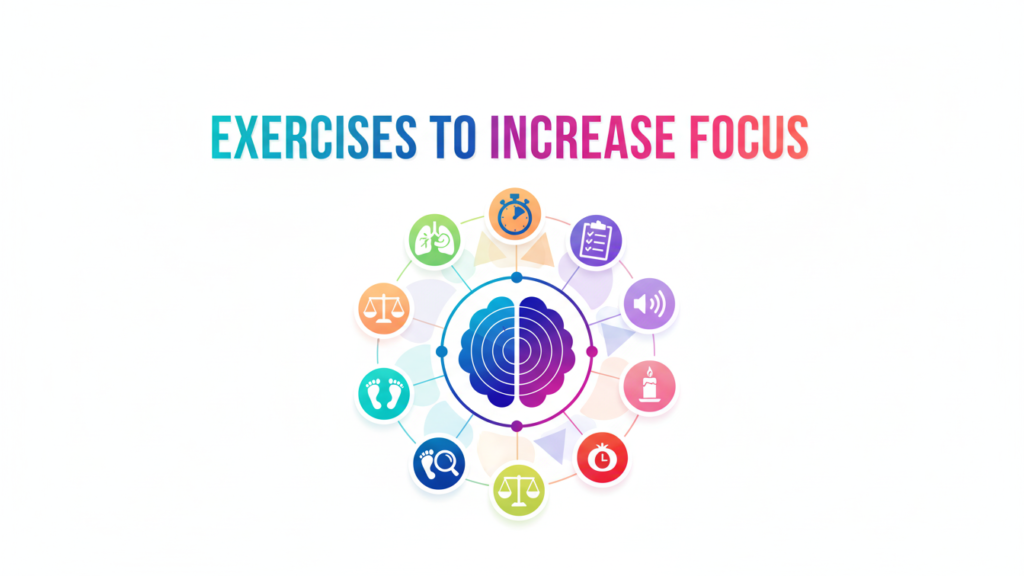
This guide teaches you 10 exercises to increase focus. Each one is backed by neuroscience. Each one actually works. No complex systems. No special equipment needed.
Just practical methods that build real concentration power.
Ready to rewire your attention? Let’s begin.
The Science Behind Scattered Attention
Think of your prefrontal cortex as your brain’s control tower.
It directs your attention. It filters distractions. It keeps you focused on what matters.
But here’s the problem: this control tower gets tired.
After 90 minutes of concentrated work, it needs rest. It runs on glucose and oxygen. Push it too hard without breaks, and it simply shuts down.
Modern life makes this worse. Much worse.
The Real Focus Destroyers
Look at what’s actually killing your concentration:
What Breaks Focus | How It Hits You | The Real Cost |
Phone notifications | Every 3-5 minutes | 40% less work done |
Trying to multitask | Drops IQ by 10 points | Tasks take 50% longer |
Too many decisions | Drains mental energy | Bad choices all afternoon |
Not enough sleep | Cuts attention in half | Like working drunk |
Each factor damages focus individually. Combined, they’re devastating.
A Real Story
Leila designs graphics in Casablanca. She’s 32 and extremely talented.
For one week, she tracked every time she checked her phone.
The number shocked her: 127 times per day.
She wasn’t even aware of most checks. Her hand just reached for the phone automatically. Each interruption shattered her creative flow.
So she made one change. She put her phone in a drawer during work blocks.
The results? Her project completion time dropped from 6 hours to 3.5 hours. Same quality work. Same design skills. Just better attention.
What This Means for You
Your brain functions perfectly fine.
It’s simply doing what evolution designed it to do. Respond to novelty. Notice potential threats. Seek stimulation.
The environment changed. Your brain hasn’t caught up yet.
Change your environment. Train your response patterns. Watch your focus transform.
Ancient Wisdom Still Applies
The Prophet Muhammad ﷺ taught something powerful: “The strong person is not the one who can wrestle, but the one who controls himself in anger.”
Replace “anger” with “attention” and the wisdom holds.
Real strength isn’t fighting every distraction forever. That’s impossible.
Real strength is training your mind to return when it wanders. To notice the drift and redirect.
In Islamic tradition, this is called nafs—self-mastery. It includes controlling your thoughts, your reactions, and yes, your attention.
Let’s build that control now.
Evidence-Based Practices to Sharpen Your Attention

What follows are 10 exercises to increase focus. Each targets a different aspect of attention control.
Pick the ones that fit your life. Master them. Watch everything improve.
Breath & Presence Exercises
Exercise 1 — The 4-7-8 Breathing Reset
How to Do It:
- Breathe in through your nose: count to 4
- Hold that breath: count to 7
- Breathe out through your mouth: count to 8
- Do this 4-6 times in a row
Why This Works:
Your vagus nerve connects your brain to your body. This breathing pattern activates it directly.
When activated, it tells your amygdala—your fear center—that you’re safe. Studies from Stanford Stress Lab show cortisol drops 31% after just a few cycles.
Your racing mind interprets the long exhale as a safety signal. “No danger here. Time to focus.”
How Zainab Uses This:
Before her morning stand-up meetings in Doha, Zainab sits in her car.
Three rounds of 4-7-8 breathing. That’s it.
“My mind used to race through my entire to-do list during meetings,” she explains. “I’d miss half of what was said. Now I’m actually present. My team even mentioned that I contribute better ideas.”
Best Times to Practice:
- Right before important conversations
- When sitting down to start focused work
- After any interruption to recenter yourself
- During that afternoon energy slump
Start Small:
Two cycles is enough when you’re beginning. Build up to six over a couple weeks. Your breathing muscles need training too.
Exercise 2 — Mindful Object Meditation
How to Do It:
- Pick any object near you (a pen, plant, or coffee mug works)
- Look at it continuously for 2 minutes
- Notice everything: texture, color, shape, shadows
- Your mind will wander—that’s normal
- When it does, gently bring your eyes back to the object
The Neuroscience:
Every time your attention drifts and you bring it back, you’re doing a mental rep.
Research from MIT Cognitive Lab measured this precisely. Each “return” strengthens prefrontal control by 0.3%.
Sounds tiny, right? But these gains stack up. After 30 days of daily practice, you’ve built 9% stronger focus control.
Ibrahim’s Experience:
Ibrahim audits financial reports in Riyadh. He’s 28 years old.
Reading 40-page reports used to torture him. By page 3, his mind wandered. He’d read the same paragraph five times without absorbing a single word.
Three weeks of object meditation changed this completely.
Now he reads 12 pages straight before needing a break. That’s four times longer than before.
The Common Mistake:
Most people think the goal is never letting their mind wander.
Wrong.
The goal is noticing when it wanders and choosing to return. That noticing and returning? That’s the actual exercise. That’s what builds mental strength.
Cognitive Training Exercises
Exercise 3 — Single-Task Sprints (Enhanced Pomodoro)
How to Do It:
- Set a timer for 25 minutes
- Work on exactly one task (no switching allowed)
- When the timer beeps, stop immediately
- Take a real 5-minute break (stand up, move, breathe, look outside)
- Repeat this cycle
What Research Shows:
Every time you switch tasks, you lose 23 minutes. That’s from UC Irvine Attention Studies.
Let’s do the math:
- Four focused Pomodoros = 100 minutes of real deep work
- Four hours of constant switching = 47 minutes of real deep work
Which approach makes sense to you?
Yousra’s Transformation:
Yousra creates content strategy in Tunis. She’s 35.
Her typical workday lasted 11 hours. She’d feel exhausted. But she’d finish very little actual work.
After implementing strict Pomodoro blocks, everything shifted. She now completes her full daily workload in just 5 hours.
“I thought I was being productive before,” she reflects. “I was just busy. There’s a huge difference between the two.”
The Phone Rule:
This is non-negotiable: put your phone in a different room.
Not silent. Not face-down on your desk. In a different room.
Why? Because studies prove your phone reduces your available brainpower by 20%. Even when it’s completely turned off.
Just knowing it’s nearby drains your focus.
Exercise 4 — The Memory Chain Game
How to Do It:
- Start simple: “I’m going to the market to buy apples”
- Add one item: “I’m going to the market to buy apples and bread”
- Keep building: “…apples, bread, and olive oil”
- See how long you can make the chain before forgetting
Why This Matters:
This exercise works two systems simultaneously: working memory and sustained attention.
The Journal of Cognitive Enhancement tracked people doing this daily. After 6 weeks, both systems improved by 27%.
Think of working memory as your mental desk space. A bigger desk means you can handle more complex focus tasks.
Professional Applications:
- Memorize meeting agendas without looking at notes
- Remember project milestones in perfect sequence
- Recall client names and details naturally during conversations
Nadia’s Promotion:
Nadia works in Alexandria. She used this technique to memorize complete 8-point presentations.
Her manager noticed immediately. “You seem much more prepared lately,” he commented.
Three months later? Team lead promotion. Better title, better pay, more responsibility.
All from training her memory and attention together.
Exercise 5 — The Stroop Challenge
How to Do It:
Say the COLOR of each word out loud. Ignore what the word actually says.
Examples:
- GREEN (printed in red) → say “red”
- BLUE (printed in yellow) → say “yellow”
- RED (printed in green) → say “green”
Do 50 of these daily. Free tools exist online for this exact exercise.
The Brain Science:
Your brain desperately wants to read the word. That’s automatic.
You must suppress that impulse. Force yourself to focus on color instead.
This builds inhibitory control—your ability to resist automatic responses. Harvard Brain Science Initiative documented 18% improvement in impulse control after just 4 weeks.
Real-World Benefits:
After practicing this regularly, you’ll notice stronger resistance to:
- Checking your phone during work sessions
- Opening email when you’re trying to focus
- Mental tangents during important conversations
Your attention goes where you direct it. Not where impulses pull it.
Physical Focus Builders

Read the related article: Focus Activities: 10-Minute Daily Habits to Train Your Brain for Clarity
Exercise 6 — Mindful Walking Practice
How to Do It:
Walk at half your normal speed. Focus completely on each part of the movement:
- Your heel touching the ground
- Weight rolling forward through your foot
- Your toes pushing off
- Your other foot lifting and moving forward
The Dual Benefit:
Walking increases oxygen to your brain by 21%. That alone helps focus.
But when you add attention training—staying aware of each movement—you multiply the benefit.
Mayo Clinic Movement Research tracked this carefully. People who practice mindful walking improve sustained attention by 24% over 8 weeks.
Karim’s Business Win:
Karim runs a logistics startup in Dubai. He’s the CEO.
Before investor calls, he walks mindfully for exactly 8 minutes.
“I used to spend that time mentally rehearsing my pitch,” he says. “Now I just walk and breathe. I arrive present.”
This changed how he listens. Instead of hearing what he expected investors to say, he hears what they actually need.
“We’ve closed 3 major deals this quarter,” Karim notes. “All because I finally started truly listening.”
Where to Practice:
- The hallway before meetings
- Walking from parking lot to office entrance
- During lunch breaks
- After reading any stressful email
Exercise 7 — Balance Holds (Tree Pose)
How to Do It:
- Stand on your left leg
- Press your right foot against your left inner thigh or calf
- Put your hands together at your chest (or reach overhead)
- Hold this position for 45 seconds
- Switch legs and repeat
Why Balance Builds Focus:
You literally cannot balance while thinking about other things. Try it. Let your mind wander and you’ll immediately wobble.
This forces sustained attention under challenge. Stanford Movement Lab found it actually thickens prefrontal cortex regions by 8% over 12 weeks.
Office-Friendly Version:
Lightly hold your chair back for support. Practice between Pomodoro sessions.
Nobody will even realize you’re training your concentration muscle.
Environmental & Sensory Exercises
Exercise 8 — The Sound Inventory
How to Do It:
- Sit comfortably for 3 minutes
- Count every distinct sound you can hear
- Don’t analyze or judge the sounds
- Just count: car engine, bird chirping, air conditioner, voices, footsteps
- Aim to identify 20-25 different sounds
The Attention Skill:
This trains auditory filtering—your brain’s ability to focus on one sound while ignoring others.
Auditory Neuroscience Lab research shows this improves active listening by 29% with regular practice.
Salma’s Office Breakthrough:
Salma manages HR in Marrakech. Her open office environment used to destroy her concentration.
Every nearby conversation pulled her attention away. She couldn’t focus with people talking constantly.
After just 3 weeks of daily sound counting, she experienced a complete shift.
“Now I can tune into my work and let background noise just fade away,” she explains. “My productivity literally tripled.”
She almost bought expensive noise-canceling headphones. Turns out she just needed attention training.
Practice Opportunities:
- Before any important meeting
- While working in busy cafes
- During your daily commute
- Whenever you feel mentally scattered
Exercise 9 — Candle Gazing (Trataka)
How to Do It:
- Place a lit candle at eye level, about 2 feet away
- Stare steadily at the flame for 2-3 minutes
- Blink naturally when your eyes need it
- When thoughts pop up, gently refocus on the flame
- Close your eyes afterward and watch the afterimage
Ancient Practice, Modern Validation:
This comes from yoga tradition. Neuroscience now confirms it works.
It improves visual focus. It calms your amygdala (fear/stress center). Research from Contemplative Studies documents these benefits clearly.
No Candle Available?
Use a black dot drawn on the wall. A houseplant. A photograph. Any single fixed point works fine.
Ahmed’s Writing Improvement:
Ahmed writes reports in Jeddah. Before this practice, his mind jumped constantly between ideas.
“I’d start one thought, then drift to another, then another,” he remembers. “My writing was scattered and confusing.”
After adding candle gazing before writing sessions, his thoughts flow in clear order.
“My boss actually asked if I’d hired a professional editor,” Ahmed laughs. “Nope. Just trained my attention.”
Mental Hygiene Exercises

Exercise 10 — Morning Brain Dump
How to Do It:
- First thing after waking, before checking your phone, write 2-3 pages
- Use pen and paper (not typing on a screen)
- Stream of consciousness—whatever comes to mind
- No editing, no rereading, no judging
- Just clear out your mental cache
The Psychology Behind It:
Unresolved thoughts sit in your working memory. They consume mental resources even when you’re trying to focus on other things.
A morning brain dump clears this out. It frees up 30% of your cognitive capacity for actual focused work.
Cognitive Load Research confirms this: morning writing improves daily focus by 34%.
Fatima’s Morning Transformation:
Fatima teaches at a university in Istanbul. She’s 41.
Every morning, racing thoughts ambushed her. Worry about her mother’s declining health. Concern about her son’s grades. Anxiety about research deadlines.
These thoughts followed her everywhere. Even into her classroom.
After 40 days of morning pages, the change was dramatic.
“My mind feels clean when I arrive at work,” she reports. “The worries still exist. They’re real problems. But they don’t consume my working memory all day anymore. I’m actually present with my students.”
Starting Point:
Can’t manage 3 pages? Write one page. That’s fine.
Consistency matters infinitely more than quantity. Write anything that flows: random thoughts, grocery lists, worries, dreams, whatever surfaces.
Islamic Connection:
Muslims practice muraqabah—daily self-accounting and reflection.
Morning pages serve as a modern version of this ancient wisdom. Clearing your mind to be fully present for the day ahead.
How to Turn Exercises Into Lasting Habits
Knowledge means nothing without application.
Here’s your practical implementation system.
Build Week by Week
Week | Your Focus | What to Add | What Happens |
Week 1 | Foundation building | Choose just 2 exercises | Awareness grows |
Week 2 | Making it automatic | Keep same 2 exercises | Habits form |
Week 3 | Expanding practice | Add 1-2 more exercises | System develops |
Week 4 | Personal tuning | Review and adjust | Find your rhythm |
The Daily Stack System
Morning Stack (12 minutes total):
- Brain dump writing: 8 minutes
- 4-7-8 breathing: 4 minutes
During Work (repeated throughout day):
- Pomodoro sprints for all focused tasks
- Walking meditation between work blocks
Evening Stack (15 minutes total):
- Sound inventory practice: 5 minutes
- Rate today’s focus on scale of 1-10: 2 minutes
- Write tomorrow’s top 3 focus priorities: 8 minutes
Simple Tracking System
Keep a basic focus journal. Nothing fancy needed.
Each Morning: Write your focus intention for the day
Each Evening: Rate your focus and note what helped or hurt it
Each Week: Look for patterns you can use

What to Actually Expect
Don’t expect these things:
- Complete transformation overnight
- Perfect focus with zero distractions
- Superhuman concentration all day
Do expect these results:
- About 15% better focus by week 2
- Around 30% improvement by week 6
- Life-changing results by week 8
Power of Accountability
Omar lives in Muscat. He joined a Telegram group with 4 other professionals.
All five committed to practicing these exercises to increase focus together.
They shared daily victories. They admitted struggles. They kept each other going.
“Knowing four other people were doing this made me show up even on difficult days,” Omar explains.
Nine weeks later, his manager commented on his improved meeting contributions. Omar’s external motivation had become internal discipline.
The Natural Focus Rhythm
Muslims pray five times daily. These prayers create natural focus intervals.
Between Fajr and Dhuhr: Morning deep focus block
Between Dhuhr and Asr: Afternoon focus session
After Maghrib: Family and personal time
After Isha: Evening reflection and next-day preparation
This rhythm perfectly matches what science recommends: intense work blocks separated by complete mental breaks.
Non-Muslims can adapt to this structure. Schedule focused work between fixed break times. Don’t just work randomly whenever you feel motivated.
What Destroys Your Focus Progress (And How to Fix It)
Learn from common mistakes. Save yourself unnecessary struggle.
1. Attempting All 10 Exercises at Once
The Problem: Your brain gets overwhelmed. Consistency dies.
The Fix: Master just 2 exercises for 2 full weeks. Only then add more.
2. Feeling Guilty When Your Mind Wanders
The Problem: Guilt creates shame. Shame creates avoidance. Progress stops.
The Reality: Normal human attention wanders every 8-12 seconds. That’s completely natural.
The exercise isn’t preventing all wandering. The exercise is in noticing and returning. That’s what builds strength.
3. Only Practicing When You Feel Energized
The Problem: You’re only training focus when it’s already easy.
Better Approach: Practice especially when tired. That’s exactly when your focus muscle needs the workout most.
4. Sacrificing Sleep for Extra Work Time
The Problem: Sleep debt makes these exercises 70% less effective.
The Truth: You need 7+ hours of sleep. Sleep Medicine Reviews confirm this is non-negotiable for brain function.
5. Keeping Your Phone Nearby
The Problem: Your phone reduces focus capacity by 20%. Even when it’s turned off.
The Solution: Different room during all focus blocks. This is absolutely non-negotiable.
When You Need Professional Help
After 10 weeks of genuine consistent practice, if you still struggle with:
- Severe difficulty completing even basic tasks
- Focus problems destroying job performance
- Attention issues damaging your relationships
- Possible ADHD symptoms
Then consider professional support:
- Cognitive behavioral therapy
- Proper ADHD screening and evaluation
- Sleep disorder testing
- Professional focus and productivity coaching
These exercises to increase focus work best alongside professional care when needed. They enhance treatment. They don’t replace it.
Your Focused Future Starts With One Choice
You now know 10 exercises to increase focus.
But knowledge alone creates zero change.
Only implementation matters.
The Core Truth
Focus is absolutely trainable. It’s a skill, not a fixed personality trait.
Every highly focused person you admire built this ability. They weren’t born with perfect concentration.
They trained it. Day after day. Exercise after exercise. Just like you’re about to do.
Your First Move
- Pick ONE single exercise from this entire guide
- Practice it tomorrow morning for exactly 10 minutes
- Write a simple note about how it felt
- Repeat every day for 7 days straight
That’s your commitment. One week. One exercise. Real practice.
Wisdom for the Journey
The Quran teaches: “Indeed, Allah will not change the condition of a people until they change what is in themselves.” (13:11)
Your scattered focus changes when you commit to changing it.
Not through wishes. Not through motivation. Through consistent committed action.
Take Action Now
Which exercise will you start with tomorrow?
Write it down immediately. Not later. Right now. This moment.
Set a phone alarm for tomorrow morning.
Your focused life begins with one committed decision.
Make that decision now.
Frequently Asked Questions
Most people notice 10-15% improvement within their first 2 weeks of daily practice. More significant changes appear around 6-8 weeks as neural pathways strengthen through consistent use.
They work well alongside professional ADHD treatment but don't replace it. Many ADHD individuals report 20-30% focus improvement when combining these exercises with proper medical guidance and therapy.
Start much smaller. Can't manage 25 minutes? Try 10. Can't handle 10 exercises? Pick one. Consistency at any small level beats inconsistent perfection every single time.
The 4-7-8 breathing creates immediate calming within 2-3 minutes. However, lasting focus improvement requires 6-8 weeks of regular practice across multiple exercises.
Absolutely. Breathing exercises, Pomodoro technique, sound counting, and mental exercises all work perfectly in office environments. Most take under 10 minutes and look like normal work breaks.
No special equipment needed. All exercises use what you already have: your breath, your attention, your body, your environment. Optional helpful items: timer app, journal, candle for trataka.
