
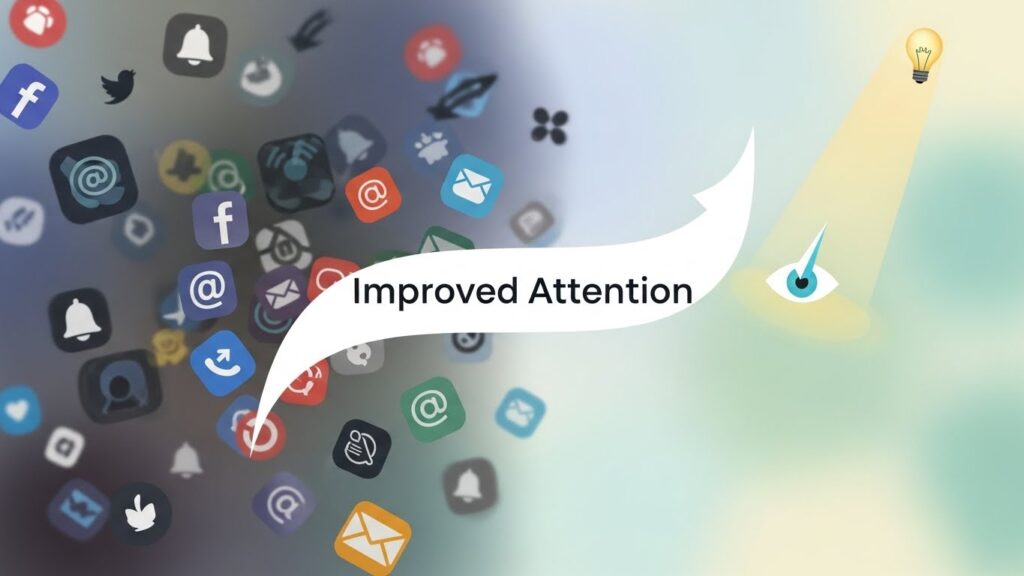
Priya from Mumbai sat at her laptop for three hours straight.
She checked her phone 47 times. Refreshed her email twice. Opened Instagram four times. And somehow forgot what she was working on.
Sound familiar?
You’re not alone. The average person now has an attention span of just 8 seconds. A goldfish? 9 seconds.
Digital distractions steal 2.5 hours from your day. Brain fog kills your career growth. It ruins important decisions. It even affects your relationships.
But here’s the good news: your brain can change.
In this guide, you’ll discover 12 exercises to improve focus and attention. These are simple, science-backed practices. No complicated systems. No expensive tools.
Just proven methods that work.
Let’s start with why your brain struggles to focus—and what actually works.
Understanding How Attention Really Works
Think of your prefrontal cortex as your focus muscle.
Just like your biceps, it gets tired. After 90 minutes of deep work, it needs rest. It runs on glucose and oxygen. Without breaks, it simply stops working well.
But modern life attacks this muscle constantly.
What Kills Your Attention
Digital overload retrains your brain for distraction. Every notification teaches your mind to jump. Every ping weakens sustained attention.
The multitasking myth cuts your productivity by 40%. Your brain doesn’t actually multitask. It switches rapidly between tasks. Each switch costs you focus.
Decision fatigue drains mental energy. Should you answer that text? Check that email? Buy this or that? Small choices add up. They exhaust your attention reserves.
Poor sleep cuts focus capacity in half. Seven hours or less? Your prefrontal cortex works at 50% capacity.
Real Life Example
Ahmed, a 29-year-old engineer from Riyadh, tracked his focus for one week.
He discovered he checked his phone 89 times daily. Mostly out of habit. Not necessity.
After implementing phone-free work blocks, his project completion speed increased 35%. Same brain. Different environment.
Here’s what you need to know: Your brain isn’t broken.
It’s responding to your environment. Change the environment. Change the focus.
Ancient Wisdom Meets Modern Science
The concept of muraqabah (mindful awareness) in Islamic tradition teaches presence. When the Prophet ﷺ spoke, he gave full attention to the person before him.
This ancient wisdom aligns perfectly with modern neuroscience. Single-pointed focus brings excellence. Whether you’re praying, working, or learning.
Science-Backed Exercises to Sharpen Your Attention

Breathing & Mindfulness Exercises
1. Box Breathing (4-4-4-4 Method)
What It Is:
- Inhale for 4 seconds
- Hold for 4 seconds
- Exhale for 4 seconds
- Hold for 4 seconds
- Repeat 5 cycles
Why It Works:
Box breathing activates your parasympathetic nervous system. This calms your amygdala. It reduces mental noise by 23%, according to recent Stanford research.
Your racing thoughts slow down. Your mind becomes clear.
Real Application:
Sara from Warsaw uses this before important meetings. She does 3 rounds in the bathroom.
“My mind stops racing,” she says. “I hear what people actually say instead of planning my response.”
Quick Start Guide:
- Morning: 2 minutes after waking
- Pre-work: Before focused tasks
- Evening: To transition from work mode
Navy SEALs use this technique in combat. You can use it at your desk.
2. Body Scan Meditation
What It Is:
A 5-minute mental journey from your toes to your head. Notice sensations. Don’t judge them. Just observe.
Why It Works:
This trains your attention to anchor in the present moment. It improves sustained focus by 16%, based on JAMA research.
Your mind learns to stay where you place it.
Practical Tip:
Use free apps like Insight Timer or Headspace. The 5-minute versions work best for beginners.
Real Success Story:
Youssef, a 34-year-old marketing director from Cairo, struggled with afternoon brain fog.
After 2 weeks of lunch-time body scans, his 3 PM energy crashes disappeared. His team noticed he stayed sharp in late meetings.
Cognitive Training Exercises
3. Single-Task Sprints (Pomodoro Method)
What It Is:
- 25 minutes: one task only
- 5 minutes: complete break
- Repeat 4 times
- Take a 15-minute break
Why It Works:
This trains your brain for sustained attention. It eliminates task-switching costs.
Every time you switch tasks, you lose 23 minutes recovering full focus. The Pomodoro method protects you from this loss.
Real-World Success:
Marcus, a software developer in Berlin, doubled his coding output using this method.
His secret? Phone in another room. Browser closed. One task visible on his screen.
“I finish in 4 hours what used to take me 8,” he says.
Common Mistake:
Don’t skip the breaks. Breaks aren’t wasted time. They’re when your brain consolidates learning and recharges attention.
4. Memory Palace Technique
What It Is:
Visualize a familiar location. Your childhood home works perfectly.
Place information in specific spots. The front door. The kitchen table. Your bedroom closet.
Mentally walk through to recall everything.
Why It Works:
This engages spatial memory plus attention systems. Together, they improve working memory by 30%, according to PNAS studies.
Athletes use this for game strategies. Students use it for exams. You can use it for presentations.
Career Applications:
- Remember meeting points without notes
- Recall presentation details perfectly
- Learn new skills 30% faster
Inspiring Example:
Fatima from Jeddah used her childhood home as a memory palace for her master’s thesis.
She memorized 50 research points. No notes. No cards.
She aced her defense. The panel asked how she remembered everything. She smiled and thought of her grandmother’s kitchen.

5. The Stroop Test Practice
What It Is:
Name the COLOR of words, not what they say.
Example: RED (written in blue ink → you answer “blue”)
It feels hard at first. That’s the point.
Why It Works:
This trains selective attention. It strengthens impulse control. It activates your prefrontal cortex like a gym workout activates muscles.
Daily Practice:
- Do 50 trials daily (free at strooptest.com)
- Track improvement weekly
- Notice your decision-making gets sharper
After 3 weeks, most people notice they make better choices under pressure.
6. Walking Meditation
What It Is:
Walk slowly. Focus entirely on:
- Foot lifting off the ground
- Moving forward through air
- Touching ground again
- Weight shifting to the other foot
Why It Works:
This combines movement with mindfulness. It increases oxygen to your brain. Research shows it improves attention by 19%.
Real Story:
Karim, an entrepreneur in Dubai, walks 10 minutes before client calls.
“I arrive mentally present,” he explains. “Not distracted by my to-do list. My clients notice I listen better.”
Beginner Tip:
Start with 5 minutes in a quiet hallway or park. Speed doesn’t matter. Attention does.
7. Yoga Tree Pose (Balance Practice)
What It Is:
- Stand on one leg
- Place your other foot on your inner thigh
- Arms overhead or at chest
- Hold 30 seconds each side
Why It Works:
Balance requires intense focus. You can’t think about email while balancing. One distracted thought and you fall.
This trains sustained attention. Harvard research shows it thickens cortical regions responsible for focus.
Office Version:
Do this at your desk. Hold the back of your chair for support. Nobody will even notice.
Visual & Sensory Exercises
8. Candle Gazing (Trataka)
What It Is:
- Place a candle at eye level, arm’s length away
- Stare at the flame for 1-3 minutes
- Close your eyes
- Visualize the afterimage
Why It Works:
This ancient practice meets modern neuroscience. It improves visual attention. It calms mental chatter.
Your racing thoughts simply stop.
Modern Application:
No candle? Use any fixed point. A black dot on the wall. A plant. A photo.
User Experience:
Amina from Casablanca does this before writing articles.
“My mind stops jumping between ideas,” she says. “I write with clarity. My first drafts are now publishable.”
9. Sound Counting Exercise
What It Is:
- Sit quietly for 2 minutes
- Count distinct sounds
- Don’t judge them
- Just count
- Aim for 15-20 sounds
Why It Works:
This trains auditory attention. It improves active listening. The skill transfers to work focus.
You’ll notice details you used to miss.
When to Use:
- Before important conversations
- During your commute (eyes closed)
- When feeling mentally scattered
Habit-Based Exercises
10. Morning Pages (Brain Dump)
What It Is:
Write 3 pages longhand every morning.
- No rules
- No editing
- No rereading
- Pure stream of consciousness
Why It Works:
This clears mental clutter. It frees up working memory. It improves focus for the rest of your day.
Think of it as emptying your mental trash bin before starting work.
Success Story:
Tomasz, a 41-year-old teacher in Krakow, struggled with racing thoughts.
After 30 days of morning pages, he reported: “My mind feels organized. I don’t carry yesterday’s stress into today. My students say I’m more present.”
Quick Start:
Begin with 1 page. Consistency beats quantity. Write anything. Grocery lists. Worries. Dreams. Whatever comes.
11. Digital Sunset Routine
What It Is:
- 90 minutes before sleep: no screens
- Read instead
- Walk instead
- Talk instead
- Prepare tomorrow’s priorities on paper
Why It Works:
Blue light disrupts sleep. Poor sleep kills focus. This routine protects your morning attention.
The Numbers:
People sleeping 7+ hours show 47% better focus than those with 5-6 hours, according to recent sleep research.
Your evening routine determines your morning performance.
12. Intentional Boredom Practice
What It Is:
- 10 minutes daily
- Do nothing
- No phone
- No book
- No music
- No thoughts to organize
- Just sit and be
Why It Works:
This retrains your brain for non-stimulation. It reduces dopamine dependency. It improves natural focus.
Modern Context:
A generation raised on constant stimulation loses the ability to focus without external rewards.
Boredom practice rebuilds this muscle.
Real Transformation:
Elena from Athens, a social media manager, practiced daily boredom for 2 weeks.
“I stopped reaching for my phone every 4 minutes,” she noticed. “My creativity came back. Ideas flow again.”
How to Actually Stick With These Exercises
Knowing exercises doesn’t help. Using them does.
Here’s how to build a system that actually sticks.
Start Small
Week | Action | Goal |
Week 1 | Pick 2 exercises only | Build habit foundation |
Week 2 | Add 1 more | Gradual expansion |
Week 3 | Establish routine | Make it automatic |
Week 4 | Assess and adjust | Personalize system |
The 3-Stack Method
Morning Stack (15 minutes):
- Box breathing (5 min)
- Morning pages (10 min)
Work Stack (throughout day):
- Pomodoro sprints
- Walking breaks between sessions
Evening Stack (20 minutes):
- Digital sunset (90 min before bed)
- Body scan (10 min)
Track Your Progress
Keep a simple focus journal:
- Rate your attention daily (1-10)
- Note what helped
- Note what hurt
- Adjust based on patterns
Realistic Expectations
Timeline | Improvement | What You’ll Notice |
Week 1 | 10% | Slight clarity boost |
Week 4 | 25% | Noticeable difference |
Week 8 | 40-50% | Significant transformation |
Accountability Works
Nadia from Muscat joined a focus accountability group. Weekly check-ins kept her consistent.
After 6 weeks, her work quality improved so dramatically that she got promoted.
“The group made me show up even when I didn’t feel like it,” she says.
Natural Focus Rhythm
The five daily prayers in Islam naturally create focus intervals.
Between prayers, dedicate yourself fully to your work. This rhythm mirrors the science: focused work blocks separated by mindful breaks.
You don’t need to be Muslim to benefit from this rhythm. Just notice how regular breaks protect sustained attention.
What NOT to Do (And How to Fix It)
Learn from common mistakes. Avoid them completely.
1. Trying Everything at Once
Problem: Overwhelm kills consistency.
Solution: Master 2-3 exercises first. Add more only after these become automatic.
2. Expecting Instant Results
Problem: Brain rewiring takes time.
Reality: Meaningful change needs 4-6 weeks. Your neural pathways don’t rebuild overnight.
3. Ignoring Sleep & Nutrition
Problem: No exercise fixes chronic sleep debt.
Fix: Get 7-8 hours. Drink enough water. Eat regular meals. These are baseline requirements.
4. Practicing Only When Convenient
Problem: Inconsistent practice produces minimal results.
Solution: Schedule exercises like meetings. Make them non-negotiable.
5. Multitasking During Exercises
Problem: This defeats the entire purpose.
Truth: Give 100% attention to the practice. That’s what creates actual improvement.
When to Seek Professional Help
If severe focus issues persist after 8 weeks despite consistent practice, consider:
- Sleep disorder screening
- ADHD evaluation
- Stress and anxiety assessment
- Professional cognitive support
These exercises complement professional treatment. They don’t replace it.
Your Focus Journey Starts With One Exercise
Remember This:
- Consistency matters more than perfection
- Start small: 10 minutes daily changes everything
- Track your progress: what gets measured gets improved
- One missed day doesn’t erase weeks of progress
Your Next Step
Choose ONE exercise from this guide.
Just one.
Practice it tomorrow morning. Set a timer. Close distractions. Do it fully.
Then do it again the next day.
That’s how transformation starts.
Final Truth
Focus isn’t about eliminating all distractions. That’s impossible in 2026.
It’s about training your mind to return when it wanders.
Every time you notice your attention drifted and bring it back, you’re building that muscle.
You’re getting stronger.
Your turn: Which exercise will you try first?
Share in the comments. Your public commitment increases success by 65%, according to behavioral psychology research.
Start small. Stay consistent. Watch your focus transform.
Frequently Asked Questions
Most people notice 15-20% improvement within 2 weeks of daily 10-minute practice. Significant change appears at 4-6 weeks when neural pathways strengthen.
They complement professional treatment but aren't replacements. Many ADHD individuals report improvement combining these with prescribed strategies and medical guidance.
One missed day doesn't erase progress. Resume the next day without guilt. Consistency over time matters, not perfection. Think marathon, not sprint.
Box breathing shows immediate calming effects in 2-3 minutes. But sustainable focus improvement needs regular practice of multiple techniques over weeks.
Yes. Most take 5-10 minutes and work at a desk: breathing exercises, mental exercises, and micro-breaks. Walking meditation fits perfectly during lunch breaks.

2 thoughts on “Exercises to Improve Focus and Attention: A Science-Backed Guide to Mental Clarity”
I view something genuinely interesting about your blog so I saved to favorites.
Thank you so much! 😊 Really glad you found it interesting and saved it. Appreciate your support! 👍