
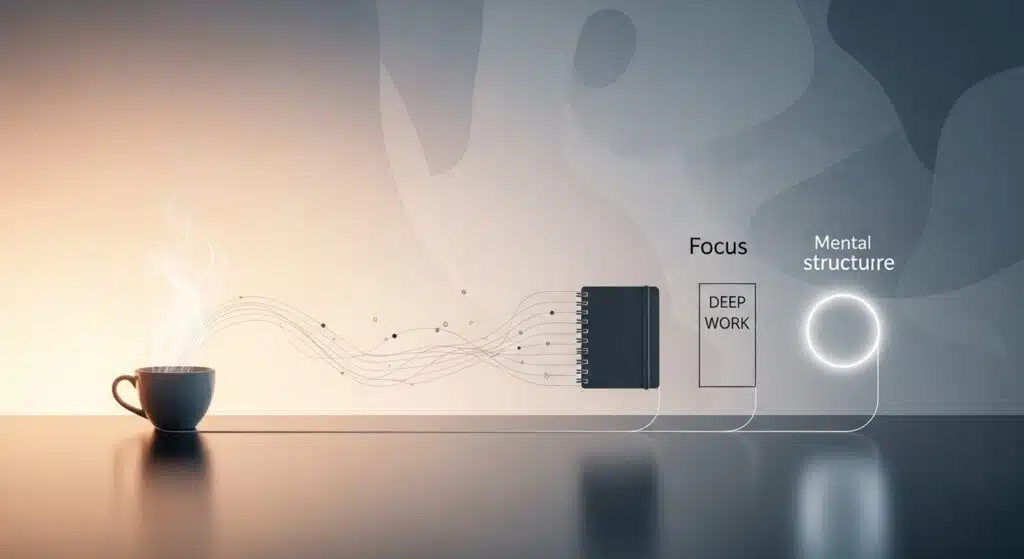
Yes, caffeine can improve focus by blocking adenosine (a sleep-promoting chemical) and increasing dopamine and norepinephrine in your brain. Research shows 50–200mg enhances selective and sustained attention, especially during routine tasks or when mildly tired. However, caffeine works best when combined with good sleep, proper timing (90–120 minutes after waking), and structured work habits. High doses (over 400mg daily) can cause anxiety, jitters, and sleep disruption, which ultimately hurt focus. Caffeine is a tool, not a replacement for sustainable focus habits like quality sleep, movement breaks, and deep work sessions.
Key Takeaway: Caffeine improves focus temporarily and conditionally-use it wisely at 1–2 cups daily, cut off by 2 p.m., and pair with healthy routines for best results.
Amira sits at her desk in Dubai. It’s 11 a.m. She’s already on her third cup of coffee.
Her brain feels wired. Her hands shake slightly. But the report she’s writing? Still half-done.
She wonders: “Does caffeine actually help me focus-or am I just fooling myself?”
If you’ve ever felt the same, you’re not alone. Millions of professionals depend on coffee to power through their days. But here’s the truth: caffeine can improve focus-but only when you use it right.
In this article, you’ll discover what caffeine really does to your brain, when it helps (and when it hurts), and how to build sustainable focus that lasts beyond your next cup.
No hype. No judgment. Just clarity.
What Is Caffeine? (The Basics You Need to Know)
Caffeine is a natural stimulant. You find it in coffee, tea, chocolate, and energy drinks.
When you drink it, it wakes up your central nervous system. You feel more alert. Your brain feels sharper.
That’s why students, remote workers, and entrepreneurs love it.
How Caffeine Works (No Jargon)
Here’s what happens in your brain:
Caffeine blocks a chemical called adenosine. Adenosine makes you feel sleepy. When caffeine blocks it, your brain stays awake.
At the same time, dopamine and norepinephrine increase. These are “feel-good” chemicals that boost alertness.
The result? You feel energized and ready to work.
Micro Case Study 1: Yusuf's Energy Trap
Meet Yusuf, 24, a software developer in Riyadh.
He used to drink five energy drinks every day. He felt wired. His heart raced.
But when he sat down to code? His mind wandered. He couldn’t finish tasks.
That’s when Yusuf realized something important: caffeine gave him energy-but not real focus.
Energy and focus are not the same thing.
What Is Caffeine? (The Basics You Need to Know)
Research from Johns Hopkins University found that 200mg of caffeine improved memory recall. Participants remembered images better the next day.
Another study published in Psychopharmacology showed that caffeine helps maintain productivity during mentally demanding tasks, but it may reduce vigilance in some cases.
A comprehensive review in Frontiers in Psychiatry confirmed caffeine’s cognitive benefits, particularly for attention and alertness, while noting individual variations in response.
But here’s what most people miss: caffeine doesn’t improve all types of focus equally.
Two Types of Focus Caffeine Helps
1. Attention
This is your ability to filter out distractions and stay on one task. Caffeine helps you ignore the noise around you.
2. Sustained Attention
This is your ability to maintain concentration over time. Think long meetings, study sessions, or writing reports. Caffeine keeps you alert longer.
When Caffeine Works Best
- You’re mildly tired (not exhausted)
- Your task is routine or repetitive
- You use caffeine occasionally (not daily)
When Caffeine Fails
- You’re already anxious or stressed
- You’ve had too much (over 400mg daily)
- You’re sleep-deprived (caffeine masks the problem but doesn’t fix it)
Micro Case Study 2: Layla's Less-Is-More Discovery
Layla, 31, works as an HR consultant in Amsterdam.
She used to drink four cups of coffee daily. By afternoon, she felt jittery. Her mind raced but couldn’t settle.
Then she tried something different: one cup in the morning. A 15-minute walk between tasks.
Her focus improved. She felt calmer. More sustained.
Layla learned that less caffeine + better structure = better focus.
The Dark Side: When Caffeine Ruins Your Focus
Caffeine isn’t always your friend.
1. The Tolerance Trap
Your body adapts fast. After a few weeks, you need more caffeine to feel the same effect.
Eventually, you’re not drinking coffee for energy, you’re drinking it just to feel normal.
Research from the Journal of Caffeine Research explains that regular caffeine use leads to receptor adaptation, requiring higher doses for the same cognitive benefits.
2. Anxiety and Jitters
High doses trigger your stress response. Your heart races. Your mind spins.
But you can’t settle on one task. That’s not focus, that’s chaos.
Studies show that caffeine doses above 400mg daily increase anxiety symptoms, particularly in sensitive individuals.
3. Energy Crashe
What goes up must come down.
The afternoon slump hits harder when caffeine wears off. You reach for another cup. The cycle continues.
4. Sleep Disruption
Caffeine stays in your system for 6–8 hours. A cup at 4 p.m. can still affect your sleep at midnight.
Research from the Sleep Foundation confirms that caffeine consumed even 6 hours before bedtime significantly disrupts sleep quality.
Poor sleep destroys tomorrow’s focus.
5. False Productivity
You feel productive. You’re busy. Moving fast.
But are you actually making progress? Or just spinning your wheels?
Problem | What Happens | Impact on Focus |
Tolerance | Need more for same effect | Focus becomes fragile |
Anxiety | Stress response triggered | Can’t settle on tasks |
Crashes | Energy drops sharply | Need another cup |
Sleep loss | Rest quality declines | Next-day focus ruined |
False productivity | Busy but not effective | No real progress |
Micro Case Study 3: Ahmed's Late-Night Coffee Mistake
Ahmed, 26, works as an accountant in London.
He drank coffee until 7 p.m. to finish reports. But then he couldn’t sleep until 2 a.m.
The next day? Exhausted. Unfocused. He repeated the cycle.
His fix: No caffeine after 2 p.m.
Sleep improved. Focus returned.
The Islamic Perspective (Natural Integration)
In Islam, moderation is a core principle: “وَلَا تُسْرِفُوا” , “Do not be excessive” (Quran 7:31).
Caffeine is a tool, not a crutch. Real strength comes from discipline, rest, and intention.
When you depend on anything excessively, you lose balance. Balance is where real focus lives.

How to Use Caffeine Wisely (Practical Strategy)
Here’s how to make caffeine work for you, not against you.
The Smart Caffeine Protocol
1. Timing Matters
Don’t drink coffee the moment you wake up.
Wait 90–120 minutes. Why? Your body releases cortisol naturally in the morning. That’s your natural alertness hormone.
Neuroscientist Dr. Andrew Huberman explains that delaying caffeine intake allows your natural cortisol rhythm to work, preventing afternoon crashes and improving overall effectiveness.
Let cortisol do its job first. Then add caffeine. It becomes more effective.
2. Dose Smartly
The sweet spot: 50–200mg
That’s 1–2 cups of coffee. More doesn’t mean better. It just means more side effects.
The FDA recommends keeping daily caffeine intake under 400mg for most adults.
3. Pair With Focus Techniques
Caffeine + structure = real productivity.
Try the Pomodoro method: 25 minutes of focused work, 5-minute break. Caffeine enhances this rhythm beautifully.
You can also explore deep work principles to maximize your focus sessions.
4. Hydrate
Caffeine dehydrates you. Drink water alongside your coffee.
Dehydration kills focus faster than you think.
5. Track Your Response
Notice how you feel:
- 30 minutes after caffeine
- 2 hours later
- 6 hours later
Adjust timing and dose based on your body’s signals.
Micro Case Study 4: Fatima's Timing Fix
Fatima, 29, works as a content strategist in Doha.
She used to drink coffee immediately after waking. By 11 a.m., she felt anxious and scattered.
Her new routine:
- Wake at 7 a.m.
- Coffee at 10 a.m.
- Pair with 90-minute deep work block
Focus improved. Anxiety disappeared.
Weekly Reset Day
Take one day off caffeine each week.
This keeps your tolerance low. You’ll feel caffeine’s benefits more strongly when you do use it.
Better Alternatives to Boost Focus (Beyond Caffeine)
Here’s the truth: caffeine is helpful, but not enough alone.
Real focus comes from lifestyle design.
Read the related article: How to Improve Your Focus
5 Natural Focus Boosters
1. Quality Sleep (Non-Negotiable)
7–8 hours nightly. Better than any amount of coffee.
According to research from the Sleep Foundation, even one night of poor sleep impairs attention, memory, and decision-making.
A study in Nature and Science of Sleep confirms that sleep deprivation reduces cognitive performance more severely than caffeine can compensate for.
2. Movement Breaks
A 5-minute walk every hour resets your attention. It increases blood flow to your brain.
Research from Stanford University shows walking boosts creative thinking by 60% compared to sitting.
3. Deep Work Blocks
90-minute focused sessions. No phone. No distractions.
This matches your brain’s natural rhythm called the ultradian cycle.
4. Nutrition That Sustains
Protein-rich breakfast. Avoid sugar crashes.
Studies from the American Journal of Clinical Nutrition show that high-protein breakfasts improve sustained attention throughout the morning.
Steady energy = steady focus.
5. Mindfulness and Intention
Start your day with a clear purpose. Ask yourself: “What’s the one thing that matters today?”
Focus follows intention.
Mindfulness research from Harvard shows that even brief meditation practices improve attention control and reduce mind-wandering.

Micro Case Study 5: Omar's System Beats Stimulants
Omar, 33, is a startup founder in Berlin.
He realized caffeine wasn’t his problem. His scattered routine was.
What he built:
- Consistent sleep schedule
- 30-minute morning walk
- 2-hour deep work block (no interruptions)
He still drinks coffee. But now it enhances an already focused mind, it doesn’t create focus from nothing.
The Career and Mindset Connection
Your career depends on consistent focus.
Not occasional bursts. Not caffeine-fueled sprints. Consistent, sustainable attention.
The Mindset Shift
Stop asking: “How can I stay energized?”
Start asking: “What drains my energy unnecessarily?”
When you eliminate energy leaks, you won’t need as much caffeine.
Research on decision fatigue shows that reducing unnecessary choices improves focus and willpower throughout the day.
Building Sustainable Focus
- Discipline beats motivation
- Small daily habits compound
- You can’t caffeinate your way to success, but you can design your way there
James Clear’s research on atomic habits demonstrates that tiny behavior changes create remarkable long-term results.
Islamic Wisdom on Work and Rest
The Prophet Muhammad (ﷺ) emphasized balance in all things. Work with focus. Rest with intention.
Productivity becomes worship when done with purpose and balance.
The concept of barakah (blessing in time) teaches that quality focus matters more than quantity of hours.
Your Action Plan
Here’s what to do this week:
Track your caffeine response , Notice patterns
Wait 90 minutes after waking before your first cup
Cut off caffeine by 2 p.m. , Protect your sleep
Build one focus habit , Try Pomodoro or a deep work block
Prioritize sleep , It’s your real superpower
Remember: Caffeine can help you focus. But you are what makes the difference.
Use tools wisely. Build habits intentionally. Watch your career transform.
FAQs
50–200mg (1–2 cups of coffee) works best for most people without causing jitters or anxiety. The FDA recommends staying under 400mg daily.
Wait 90–120 minutes after waking to let natural cortisol work first. Avoid caffeine after 2 p.m. to protect sleep quality, as research shows it can disrupt sleep even 6 hours before bedtime.
No. Caffeine masks tiredness but doesn't restore brain function. Studies confirm that quality sleep is essential for real focus and cognitive performance.
No. Genetic variations in CYP1A2 enzyme affect caffeine metabolism. Some people are highly sensitive and experience side effects at lower doses.
